
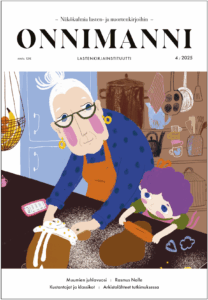
The final issue of Onnimanni for the year focuses on classics, as well as books that were once popular in their own time but now are forgotten. Among Finnish children’s literature classics, Tove Jansson’s first Moomin novel, The Moomins and the Great Flood (Småtrollen och den stora översvämningen), was published in 1945.
Maria Laakso’s essay takes a closer look at Jansson’s Moomin-novels, which gradually achieved its status as classics. The first Moomin book, published 80 years ago, was episodic in nature and overtly influenced by earlier children’s books. Today, a children’s book classic is expected to be flexible in terms of suiting different publishing platforms, being open to adaptation or to the production of commercial products based on the beloved book. A good example is the controversy that arose in Brooklyn, USA, where Jansson’s character Stinky was questioned and cancelled for containing caricatured and stereotypical features of racialized people.
Onnimanni’s editorial team asked children’s and young adult literature editors from four publishing houses to reflect on whether the mechanisms behind future classics have changed in today’s fast-paced world of publishing. If large sales figures and multiple editions are used as criteria, even very recent children’s books can now meet the hallmarks of a classic. An unstable societal climate seems to favour especially children’s book classics, which offer readers a sense of comfort and security.
Hellevi Hakala has studied Finnish girls’ and boys’ books from the 1920s and 1930s, making extensive use of various archival sources. In her article, Hakala illustrates how the digitization of archival materials has both facilitated and complicated researchers’ work. Although the material is seemingly easily accessible, researchers must still accept the randomness of archival sources and decide when enough material has been gathered.
The Danish duo Carla and Vilhelm Hansen created the comic strip character Rasmus Klump (Rasmus Nalle) in the 1950s. Literary scholar Sakari Katajamäki and nonfiction author-publisher Juri Nummelin read the comic albums and picturebooks in their childhood and have returned to them again as adults. They are convinced that Rasmus Klump’s straightforward optimism and communal outlook on life still resonate in the 2020s.
A beloved children’s book can also live on through various printed products. Avid collector Kari Elkelä has mapped the history of playing cards designed for children. In his article, he presents interesting examples of playing cards published in Finland that are based on classic children’s books or fairy tales.
Today, an increasing number of children’s book classics are turned into simplified easy-to-read versions. Silja Vuorikuru, who writes and adapts stories into easy-to-read books, expands on the kinds of decisions she has to make when the plot needs to be trimmed or when events or expressions in the original book need to be handled since they are unfamiliar to today’s children. Simplified adaptations are a proven way to promote reading equality.
Translation into English by Maria Lassén-Seger