
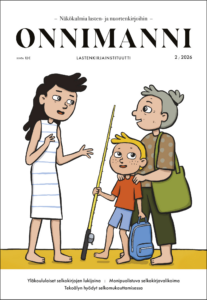
The need for easy language books has increased in recent years, and therefore the spring issue of Onnimanni focuses on easy language literature for children and young adults.
Ella Airaksinen, who works at The Finnish Centre for Easy Language (Selkokeskus), has written the editorial in easy language. She notes that a record number of new easy language books for different age groups were published last year. Nonetheless, there is still a need to expand the selection for children and young adults, since some young readers may need easy language literature only temporarily, whereas others may need them permanently.
In 2024, the Finnish Institute for Children’s Literature participated in the Selkopolku project, which distributed easy language books and otherwise easy-to-read books to all lower secondary school classes in Finland (grades 7-9, age 13-15 years). The University of Jyväskylä has evaluated the project’s impact and found that the majority of the teenagers who participated in the project, preferred reading easy language books over regular books. Also, teachers play a particularly vital role in introducing and selecting suitable easy language literature.
Reviews of easy language books for young people rarely appear in the media. Hence, Mervi Heikkilä gives a useful overview of new easy language books and adaptations published in 2025 and early 2026 for young readers. The growing appreciation of easy language is, moreover, reflected in the Klara Prize, which was founded in 2024 to highlight high-quality easy language literature for young people. Whereas today’s selection of easy language books for young adults is quite substantial, the range of easy language literature for children is still relatively limited.
WSOY and Tammi have launched a new series called Selkee, which features popular children’s, young adult, and adult books adapted into easy language with the help of artificial intelligence. Mikko Saari has interviewed easy language adapter Satu Leisko, who emphasizes that human expertise remains important in the process. Artificial intelligence assists in condensing the plot of the story, which is usually the most labour-intensive and time-consuming stage of adaptation.
J. S. Meresmaa has interviewed two authors of easy language books, Tuomas Kilpi and Marja-Leena Tiainen, as well as illustrator Aiju Salminen. They conclude that easy language always challenges creators to condense and clarify their expression.
Children’s and young adult literature today is often serialized, with authors writing book series about the same protagonist. As a result, Onnimanni has introduced a new column presenting book series. Mikko Saari has read Helena Immonen’s Purppurausvan Animaagit series (Tammi, since 2024), which features children who can transform into animals. The early books in the series are already adapted into easy language.
Kirsti Rehunen has interviewed Stefanie Tuurna, who received the Institute’s Punni Literature Prize 2026 for her debut novel Maamaa (Otava 2025).
Translation: Maria Lassén-Seger