
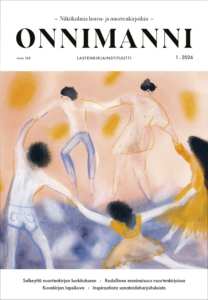
The first issue of Onnimanni in 2026 addresses current and interesting phenomena related to young adult literature.
In their article, Elina Rouhiainen and Sini Helminen shed light on the challenges involved in classifying YA literature and NA fiction. The former abbreviation refers to works aimed at young adults understood as teenagers, whereas the latter is aimed at “new adults” understood as over 18-year-olds who have recently reached adulthood. Rouhiainen and Helminen have both written YA novels themselves, and Helminen works as a librarian specialising in YA literature. The article authors highlight the intriguing new habit of publishers to classify works featuring young adult protagonists as adult fiction in an attempt to increase sales and visibility. Saara Tiuraniemi, publisher of children’s and young adult literature at Tammi, admits that these new practices within publishing should be agreed upon and clarified in cooperation with other actors in the book industry.
In her article, Ennaliina Leiwo examines Finnish young adult literature from the perspective of racial diversity. For her ongoing doctoral dissertation at the University of Turku, Leiwo has interviewed 22 Finnish YA authors. All interviewees note that diversity is now one of the core values of their YA books. Still, very few YA books authored by non‑white Finns have been published in Finland. For this article, Leiwo has talked to Aracelis Correa and Téri Zambrano, who founded the POC (People of colour) book club in 2020. She has also interviewed Maryam Abuzaid‑Ryu, a Palestinian–Korean author living in Finland, whose debut novel will be published in autumn 2026. The novel tells the story of a friendship between a Palestinian and a Sudanese girl.
Päivi Haanpää, who teaches creative writing, has organised a workshop for upper secondary school students in which they read Dess Terentjeva’s verse novel Freestyle. Through group work, the participants discussed, among other things, how different assumptions and preconceptions shape their understanding of the novel. Practical activities during the workshop supported the students’ interpretations of the novel. The workshop is part of the European G-BOOK 3 project, in which the Finnish Institute for Children’s Literature represents the Nordic countries. The project maps gender-sensitive and gender-positive YA literature.
In December 2025, the director of the Finnish Institute for Children’s Literature, Kaisa Laaksonen, defended her doctoral dissertation on child figures in Finnish picturebooks published in the early 2000s. In her study, she analyses the characteristics of child protagonists quantitatively as well as through an intersectional lens, examining the representation of gender, ethnicity, age, and setting across 246 picturebooks. Her study also covers historical conceptions of childhood over time. Laaksonen identifies three kinds of child figures in her material: (1) the child guided by adults, (2) the child longing for adult attention, and (3) the independent child.
In an interview with Päivi Heikkilä-Halttunen, Elina Druker discusses current perspectives in Swedish children’s and young adult literature research, as well as ongoing collaboration between Finnish and Swedish researchers. Since 2018, Druker is Professor of Literature with specialisation in children’s literature at Stockholm University. Her latest research project concerns the work of children’s author‑illustrator Camilla Mickwitz (1937–1989).
January 2026 brought the sad news that Onnimanni’s long‑time editor‑in‑chief, author Tuula Korolainen, passed away at the age of 77, and Maijaliisa Dieckmann, known for her historical children’s and young adult books, died at the age of 91.
Translation Maria Lassén-Seger