
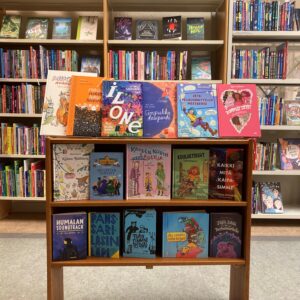
Kirjakori 2025 statistics (PDF)
Kirjakori 2025 overview (PDF)
The number of printed books for children and young people increased in Finland in 2025
Since 2001, the annual Kirjakori-overview has provided an insight into the quantities and qualities of all children’s and youth literature published in Finland. The statistics and thematic analyses are compiled by The Finnish Institute for Children’s Literature, based on books that the institute has acquired for its comprehensive collection. There are a total of 1403 books in Kirjakori 2025.
Kirjakori only includes books that are published in print: picture books, chapter books, novels for young adults, poetry, comics and graphic novels, as well as non-fiction for children and young people. The collection includes new editions, if there has been a significant change, for example new cover, illustrations or translation. The number of printed books has increased by 7 % and almost a hundred titles from the year 2024, when the total number of books was 1306. According to the statistics by The Finnish Publishers Association, the sales of children’s literature grew sligtly compared to 2024.
For the ninth year in a row, there are more domestic books than translations: 54 % of the books are domestic. The domestic books include 31 Finland Swedish books written in Swedish. The translations are mostly from English (75 %), Swedish (9 %), and German (7 %). The number of original languages is declining, while an increasing number of books are translated from English.
Ten of the largest publishing houses published around 69 % of the books in Kirjakori 2025, the total amount of publishers being 122. The publishers range from large general publishing houses to self-publishing.
Some of the most recurrent themes in youth literature include working, money and social class. In children’s books, emotions and especially children’s fears are present. Books also tell that grandparents have a meaningful role in children’s lives.
Categories in Kirjakori
Picture books
The largest category in Kirjakori consists of picture books. In Kirjakori 2025, there were a total of 511 books in this category, of which 195 were domestic and 316 were translations.
Besides the picture books, this category includes board books and play books for babies, sound books, and sensory books. 118 of the 316 translated picture books are play books for babies.
Children’s books
The category of children’s books contains easy readers, chapter books, fairy tales, and story collections for children. The number of children’s books has been on the rise since 2019. In Kirjakori 2025, this category reached its all-time high, totalling to 382 titles. 258 of the titles are domestic and 124 translations. Most children’s novels are part of a series.
Teen books
The novels in this category are aimed at readers aged 13–18, ranging from early teen books to young adult books and verse novels. Kirjakori 2025 has 222 titles in this category. The number of domestic books is rising, with record-breaking 149 books this year. There are less translations, a total of 72 books.
Non-fiction
The non-fiction category contains non-fiction picture books for small children as well as non-fiction for children and teenagers. The vast majority of the titles are aimed at children. From the total of 196 books in Kirjakori 2025,100 are domestic books and 96 translations. The number of non-fiction has stayed almost the same as in 2024.
Poetry
Compared to other Nordic countries, poetry is relatively substantial in Finland. There is a strong tradition of children’s poetry, both in reading and publishing it. In Kirjakori 2025, there are 22 titles, all of them domestic.
Graphic novels
Most comics and graphic novels published in Finland are translations. Only a selection of translated comic books is taken into the institute’s collection, which means that the number does not include every translated comic book published in Finland for children and youth. Kirjakori 2025 contains total of 48 titles: 23 domestic and 25 translated titles.
In recent years, there has been an increasing number of comic books for children, while previously they were mostly for teens or young adults.
Easy language books
Easy language is standardized in Finland and the titles for children and teens contain both fiction and non-fiction.
Some Easy language books are written directly in Easy language while some are adapted from books originally published in standard language. In Kirjakori 2025, there are 46 Easy language books. 24 of them are written directly in Easy language and 22 are adaptations.
Themes in Finnish children’s literature 2025
Class, work and money
The impact of social class in young people’s lives is one of the most important themes in children’s and youth literature in 2025, also connected to the themes of money and work.
In youth novels, the protagonist often gets new friends and notices differences between family backgrounds. In Satu Erra’s book Tällainen tunne (Tammi), Emma has moved from Northern Finland to Helsinki and studies in an art-oriented secondary school. Emma’s new friends have wealthy families that are very different from Emma’s own working-class family, and she has to work as a cleaner to pay for her living. In Marja Aho’s Chiaroscuro (Myllylahti), Fiona has a well-of family where everyone is interested in culture. One day, someone is trying to steal Fiona’s bag on a street and a handsome boy riding a motorcycle helps Fiona. Getting to know Rafa leads Fiona to understand how different lives young people live if their parents are unemployed and don’t even have enough money for food.
In the books, description of young people working is connected to situations where families are unprivileged and poor, or when young people need to finance their living when studying far from home. In Taina Niemi’s book Varkaat (Otava), 15-year-old Luka is working at a fast-food restaurant, because his single mother doesn’t have enough money for providing Luka and his little sister. In Tiia Mattila’s novel Humalan soundtrack (Myllylahti), Iiro is collecting empty bottles to get money. His parents are unemployed and always drinking. Iiro is ashamed of being poor and is unable to tell anyone, not even his best friend.
Riina Tanskanen’s Tympeät tytöt: Luokkakipuja (Into) is a collection of comic short stories about social structures and economy, presented through everyday life experiences of young girls living in the periphery. Money is an issue even in non-fiction. For example, Ronja Roms’ and Helena Rostedt’s Näin tehdään rahaa: kaikki mitä olet halunnut tietää rahasta ja sijoittamisesta (WSOY, illustrated by Linda Pajunen) is giving young people advice on saving money and investing it.
Fears and noises
Emotions have been central in picture books throughout the 2020’s. In 2025, there are several books on handling fears. In Maryam Razavi’s and Saara Obele’s book Mimi ja mörkö (Otava), the main character, a little girl called Mimi, is afraid of the bogeyman. When she tells her family members about the fear, they take it seriously, and a figure of a furry monster taking part in cooking and dancing with the family members is presented in the illustrations. In Elina Hirvonen’s and Mervi Lindman’s Mörön oma kirja (Tammi), the main character is the bogeyman himself, telling his own story.
Sensitive children are bothered by loud noises. In the picture book Hups ja Hurrur (Tammi) by Lotta Montén and Aiju Salminen, the child is observing the refrigerator because of its weird noises. A little boy called Sauli in Heli Rantala’s and Netta Lehtola’s Mölymyrsky (WSOY) is hypersensitive to noises and therefore anxious about going to school. Kukas muu kuin Lii (Enostone) written by Eveliina Talvitie and illustrated by Jani Ikonen presents a selective mutist as a main character.
The important role of grandparents in children’s life
Grandparents have an important role in children’s and also in teenagers’ lives. Eppu Nuotio’s and Kristiina Louhi’s picture book Pikkumummu ja iso rakkaus (WSOY), presents the feelings of a new grandparent when a baby is born. Heidi Viherjuuri’s and Henna Ryynänen’s picture book Milloin mummo tulee? (Mäkelä) is a story of a child longing for the grandmother who lives far away.
Kahden kodin lauluja (S&S) by Ilja Karsikas talks about a divorce in a family. When the child feels uncertain because of the changes in family life, the grandparents are reliable and stable. In youth novel Huppu ysillä (Tammi), the teenager Huppu has always been close to his grandmother, even now when she is living in a nursing home and suffering from dementia. Picturebooks Kaarnalaivanvarustaja (WSOY) by Katariina Rosavaara and Lotta Fors, and Kun mummi unohti tarinat (Tammi) by Lotta-Sofia Saahko and Mira Mallius, are also dealing with grandparents’ illness and declining memory.